
October 2020
CONTENT:
1. Economic trends within Israel’s emerging technology market
2. Advance preview of latest LP IV investment currently being executed
3. A look ahead at November’s LP update containing a refreshed portfolio risk analysis
As a reminder, the information within these updates is confidential and we ask that you not distribute external of the partnership.
Economic Trends Within Israel’s Emerging Tech Market
As mentioned on Janvest’s Semi-Annual LP call back in August, market conditions in Israel’s innovation sector continue to dramatically shift in our direction. To refresh, we at Janvest focus exclusively on leading pre-seed and seed rounds in deep enterprise technologies being developed in Israel.
Data from Q1 to Q3 of this year indicate that despite an increase in total dollars invested in Israeli technology businesses compared to the same time last year, there has been a dramatic decline in seed investment activity in terms of the number of deals, the amount being invested, and the types of investors participating. As seed investors with more than $40MM in investable capital available, these downward trends in Israel’s early stage tech sector play well for Janvest when it comes to deal flow, deal terms, and start-up valuations.
Israel’s Technology Market Remains in High Gear
Despite the IMF’s forecast that Israel’s GDP will contract by 5.9% this year due to COVID, the country’s technology ecosystem has continued its upward trajectory and momentum when it comes to attracting investment and M&A activity.
From Q1-Q3 2020, 438 deals were executed with a total of $7.5 billion invested compared to Q1-Q3 2019 when 380 deals attracted $5.7 billion. This represents a 14% increase in deal volume and 24% increase in total dollars invested. Of those dollars invested though, 42% were directed at larger, later stage rounds.
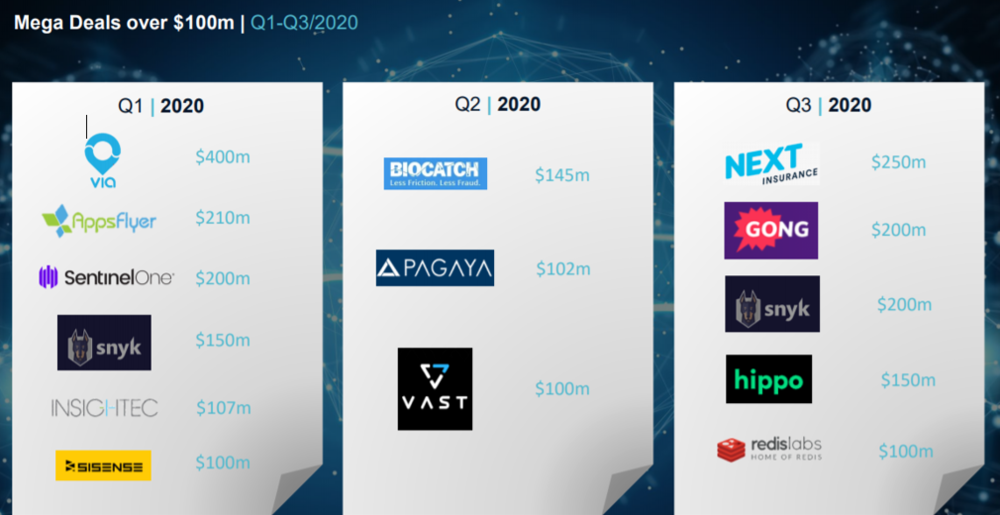
While historically these larger, later stage rounds have not necessarily resulted in higher returns for growth fund investors, things are changing in Israel. If you look at 2015, only 2 ‘exits’ or liquidity events achieved valuations greater than $500MM producing $1.7 billion in investor value. In 2019 that number jumped to 10 deals creating more than $15 billion in investor value. Thus far in 2020, there have been 7 deals generating over $11 billion in returns for investors. This data indicates that Israeli companies are effectively learning how to raise bigger rounds, manage that capital more effectively, and ultimately achieve greater results for their investors. Here is a sampling of some of Israel’s 2020 mega deals, including Janvest portfolio company BioCatch.
Seed Investment Activity Sees Dramatic Drop Off
The total number of seed deals in Israel has dropped off 30% from 2019 and 32.6% from 2018. Thus far in 2020, seed investments accounted for only 1.2% of all invested capital in Israel’s tech market, which is a near 60% drop off from 2019 and 2018.
Even more eyebrow raising is the rapid withdrawal of venture funds from the seed stage with a 60% and 65% decline in the number of VCs participating in seed rounds compared to 2019 and 2018, respectively.
There are two primary factors that play into this VC retreat from seed investing:
1. Venture funds in Israel and the U.S. have raised record amounts of capital over the last 2-3 years and as such need to write some larger checks that can have a more meaningful impact on their return profile.
2. The risk profile of many funds is changing with the current market volatility. Many funds that had the appetite and ability to write seed checks are investing in slightly more mature businesses raising A and B rounds of financing.
The final interesting data point surrounding Israel’s seed market is the cliff-like drop off in round sizes and corresponding valuations. Median seed round sizes have declined 83% from 2019 and with it has come start-up values. This translates into smaller checks buying larger equity positions in promising businesses – further indication that our desire to ‘right size’ Janvest IV from $80MM to $50MM back in Q2 was the appropriate move.
Conclusion
While we don’t know exactly what Q4 will bring in terms of investment and M&A activity within Israel’s tech market, it is safe to say that this year will be characterized by the proliferation of mega rounds ($50M+) and the rapid retreat away from seed deals, which ultimately has a positive impact on Janvest and our investment strategy:
1. Less competition for high quality seed deals
2. Lower valuations on start-ups, thus achieving higher ownership with fewer dollars
3. A return to capital efficiency as early stage financing becomes harder for start-ups to acquire
4. An increasing need amongst entrepreneurs to get commercialization support abroad earlier in their lifecycle
Despite the market conditions swinging favorably in our direction, it is important to note that our strategy will not veer and our pacing discipline will remain the same.
Source: Israel Venture Capital Association Q3 2020 Israel Tech Funding Report
Advance Look: Janvest IV’s Latest Portfolio Investment
This month we expect to complete our latest portfolio investment in a new Tel Aviv-based start-up, which is bringing to market a next generation Third Party Risk Management (TPRM) platform designed initially for banks and other financial institutions.
What is Third Party Risk Management?
As financial institutions expand globally, they increase their reliance on third party vendors, many of which come with sub-standard cyber security infrastructure, thus creating tremendous operational, reputational, compliance, financial, and strategic risk to those networks to which they connect. TPRM is the practice of assessing, managing, and eliminating that risk associated with third and fourth party vendors.
How is TPRM practiced today?
TPRM today is a very manual, expensive, and time-consuming process for most companies, especially those in the financial services arena, which have a complex and highly regulated framework for compliance. Within most banks, the process of assessing and approving a vendor can take weeks to months, but also comes with required annual assessments
What is the opportunity within the enterprise TPRM market?
TPRM is becoming a huge cost center for large enterprises that have to staff up in order to accommodate the hundreds and thousands of vendors they add annually. As such, enterprises are looking to technologies to make the vendor assessment and orchestration process more efficient and cost effective. This start-up is aiming to be the first to market with a full TPRM orchestration platform.
Company X’s Seed Round
Janvest IV is co-leading this $5M seed round with a well regarded enterprise tech-focused VC in Israel. Joining the round as a strategic investor is the venture arm of a U.S.-based Fortune 100 financial services company. Once the deal is fully executed in the coming week or two, we will be distributing more information on the company, its dynamic founding team, and the round itself.
November LP Update - Portfolio Risk Analysis
Back in May we provided an initial risk assessment of each active portfolio company categorizing by low risk, medium risk, and high risk. Since then, some of the companies have gone from low risk to medium or high risk, while others have gone from high risk to lower risk categories. In next month’s report we will provide an updated look at how each active portfolio company is doing with a corresponding forecast and what we at Janvest are doing to support each business. Here’s a very high level snapshot of that analysis:
- Reposify, an LP C portfolio company, has moved from high risk to low risk with the near completion of a $2.5MM financing round.
- Coralogix, an LP B/SPV III portfolio company, remains in the low risk category especially after closing a large $25MM Series B round and having a 7-figure annual revenue run rate for 2020 with 70% YoY growth.
- ShieldIoT, an LP C portfolio company, remains in the high risk category; however, they are in advanced discussions with a number of venture funds about a sizable Series A round to be executed this year.
- Rupert, an LP IV portfolio company, is in the low risk category after raising $2.85MM in financing this year from Janvest and NY-based IA Ventures, one of the premier seed funds here in the U.S.
Worth noting, risk is assessed with a 12 month outlook meaning that a company moving from high risk to low risk does so only in the sense that they are well capitalized for at least the coming year.