
Investment - January 2023
The Joule General Partners are pleased to announce the execution of Limited Partnership IV’s 11th investment in an Israeli founded emerging technology company. Below you will find information about the business and corresponding investment. We welcome your questions and feedback.
DEAL SUMMARY
Company Name / Qipt
Website / www.GetQipt.com
Offices / Tel Aviv, Israel
Sectors / Fintech
Founders / 3
Year Founded / 2022
Number of Board Positions Held by Joule / One
Total Joule LP IV Investment / $1,000,000
Total Size of Round / $2,500,000 (Pre-Seed)
Notable Co-Investors / FVS Fund, Selah Ventures, Shine Capital, Quantum Angels (a Bessemer scout fund), and prominent U.S. and Israeli Angel investors
LP IV Ownership / 10.0%
TECHNOLOGY DESCRIPTION
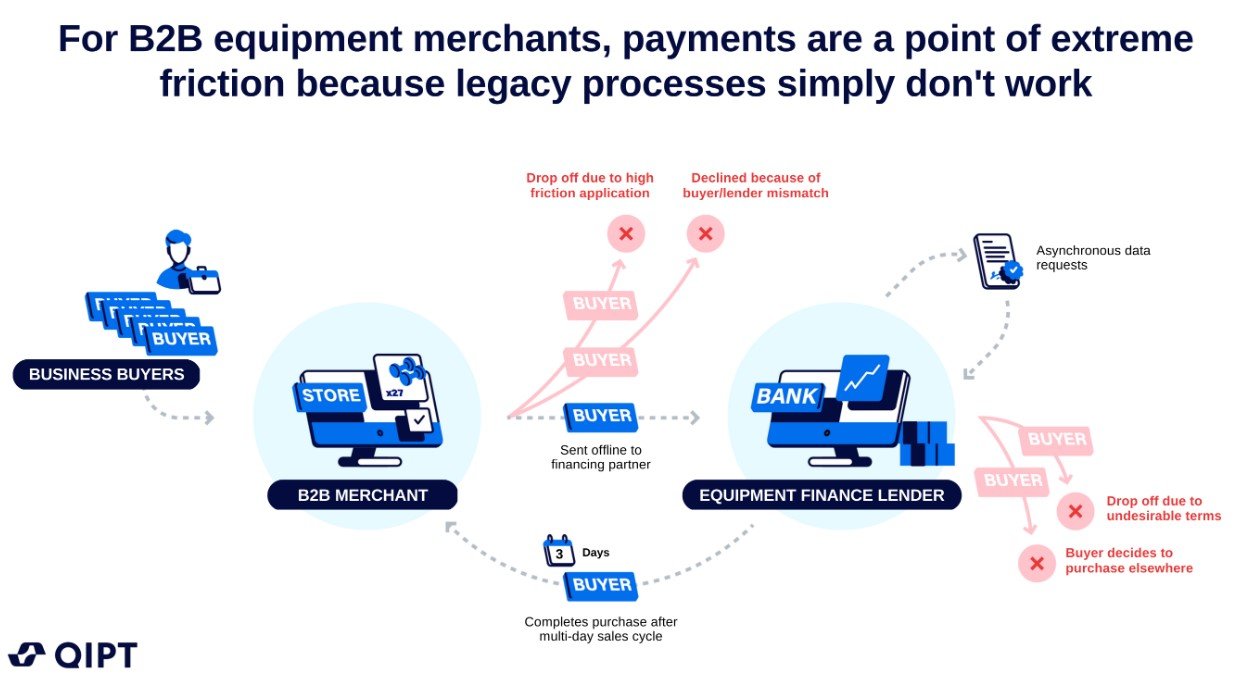
According to the Equipment Leasing and Financing Foundation, U.S. business owners purchased $2 trillion in capital equipment in the U.S. alone in 2021, with nearly half of that ($900 billion) being financed in the form of either a lease or a secured loan. While the large OEMs and equipment distributors have their own captive finance arms, they are only responsible for approximately 37% of small ticket equipment finance ($250K or less). The remaining 63%, or $220 billion, of small ticket equipment purchases are sold through equipment vendors that do not have in-house financing arms. For these merchants and their customers, payments are a point of extreme friction as legacy processes are broken. Below is a graphic highlighting some of these inefficiencies:
Such inefficiencies in other financing siloes have led to the creation of market leading businesses that make purchasing and leasing of goods much easier:
- Dealertrack: Consumer auto finance. Acquired for $4 billion by Cox Automotive
- Built: Construction equipment. Raised $312 million in venture capital
- Caribou: Auto refinance. Raised $189 million in venture capital
- Lev: Commercial mortgages. Raised $110 million in venture capital
Qipt’s view is that small equipment finance also requires a purpose-built solution with industry-specific integrations, product-level data, long-term risk analysis capabilities, a suite of payment structures, and the ability for sellers and buyers to take advantage of various tax incentives. As such, they are envisioning the delivery of the first operating system for B2B capex commerce that connects merchants and lenders to power real-time, embedded installment payments.
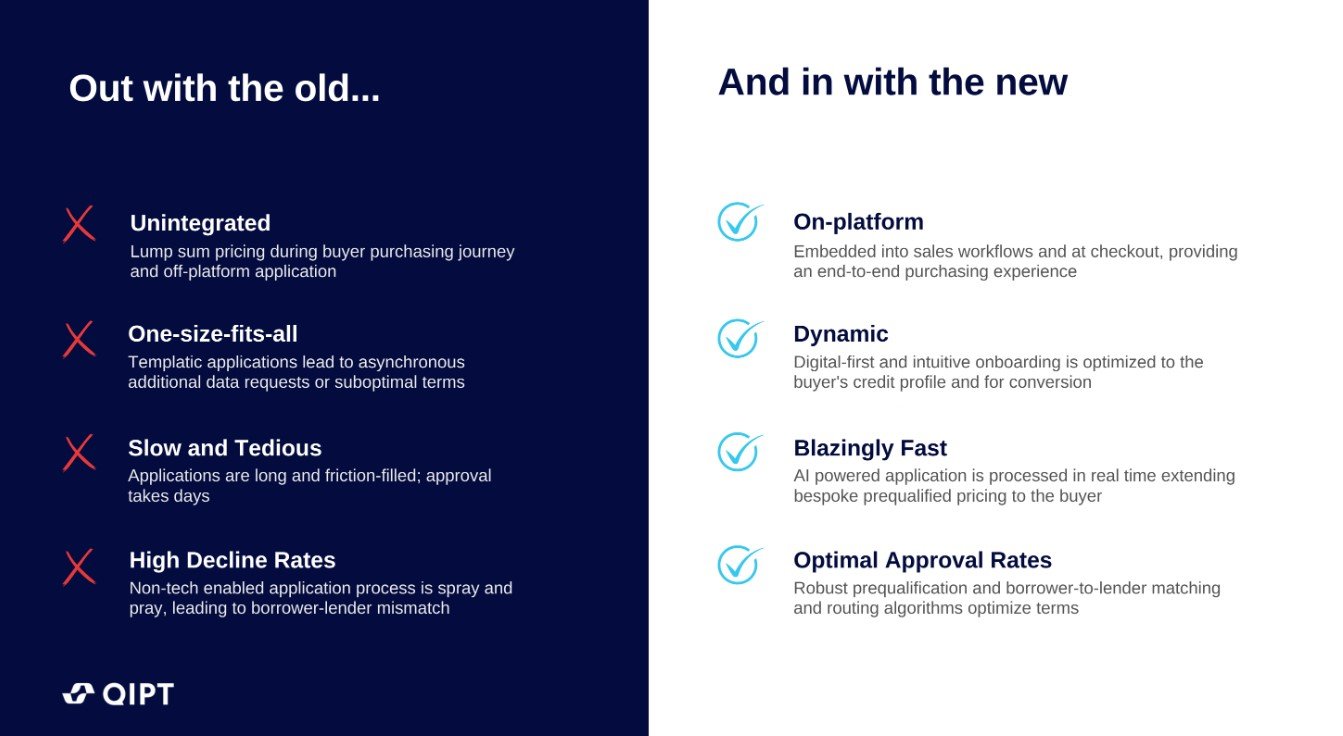
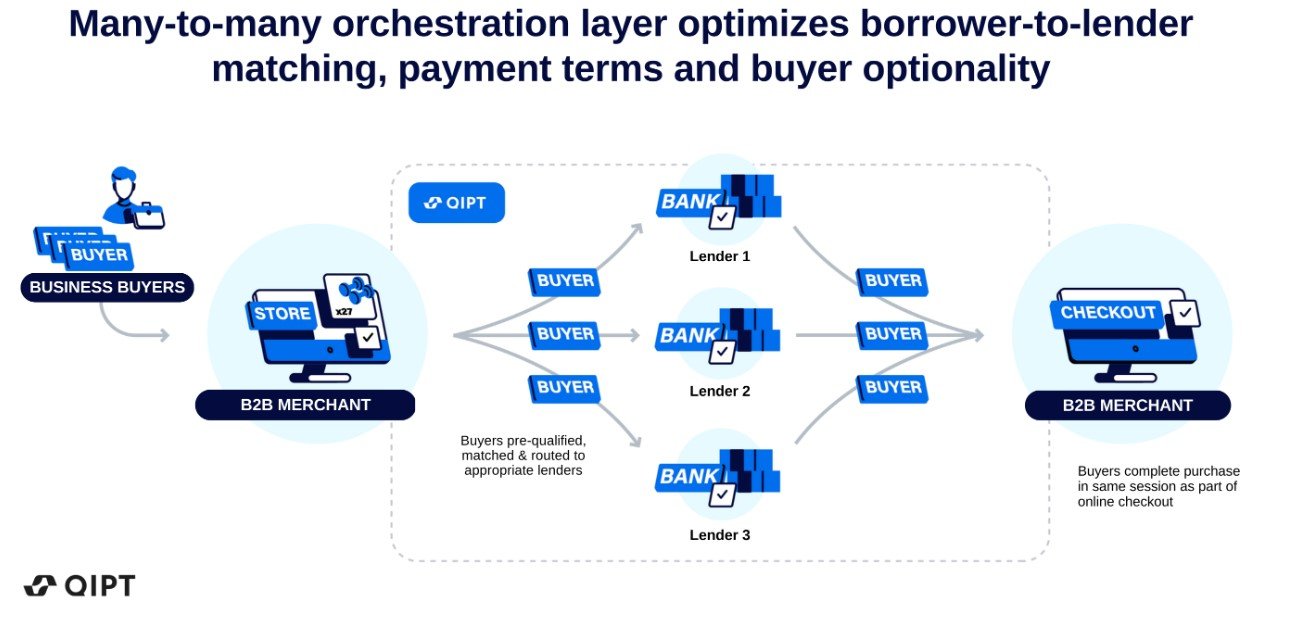
Worth clarifying — Qipt is not looking to replace the lender or take part in the underwriting, but rather to enable a more effective transmission of highly valuable and vetted buyer data so that a wider net of lenders can offer near-immediate point-of-sale terms, especially for online purchases. According to McKinsey, 77% of B2B merchants have and heavily utilize eCommerce sales channels, while 65% of buyers are willing to spend more than $50,000 online. Qipt is building to be that point-of-sale finance operating system that enables merchants to sell more, particularly online, by providing buyers with real-time visibility into equipment costs based on the various financing terms available and the ability to select from an array of payment plans that alleviate the pressure of heavy upfront out-of-pocket expenses. In parallel, Qipt aims to attract equipment financiers by offering them loan opportunities (origination) to which they would otherwise not have access. This is becoming increasingly relevant as banks are facing more competition as the dominant players in the equipment finance market. According to the Equipment Leasing and Finance Association (ELFA), in 2020, captive market share increased to 37%, up from 35.7% a year prior. At the same time, independent lenders also increased their market share from 8.9% to 10.6%. While the banks aren’t interested in $50,000 lending opportunities, via Qipt, the bundling of these small capex purchases can provide some immensely attractive volume. To make this platform function seamlessly and effectively, Qipt will need to build out numerous state-of-the-art integrations with lending partners and merchants that will require proprietary data collection and processing, as well as risk analysis and fraud detection:
While Qipt’s monetization strategy is still under development, the goal is to be able to charge a percentage of each transaction where their platform is utilized for a purchase. In addition, there may also be the opportunity to capture an origination fee from the lenders as another revenue stream. In a fast growing $220 billion market, becoming an industry leader could turn this business into a highly successful venture.
MARKET ADOPTION
Qipt understands that they need to ‘declare a major’ in terms of selecting one or two verticals to ultimately focus on in the first couple of years. However, given the early stage of this business, they are working horizontally with a variety of design partners and lenders across numerous industries to determine where they might find the best near term fit. On the merchant side, Qipt is working with a handful of small to mid-size distributors of healthcare, automotive, manufacturing, and industrial lighting equipment in the United States, which in aggregate sell roughly $155 million worth of goods annually. Other industries of interest for Qipt include materials handling, oil and gas, agriculture, transportation, and dentistry. On the lender side, they are working with four initial partners, who in aggregate service $45 billion in annual equipment finance volume. As the business matures, it is our expectation that Qipt will hone in on the market(s) where their value proposition can have the greatest impact and see the most significant growth from a revenue standpoint.
EXECUTIVE TEAM
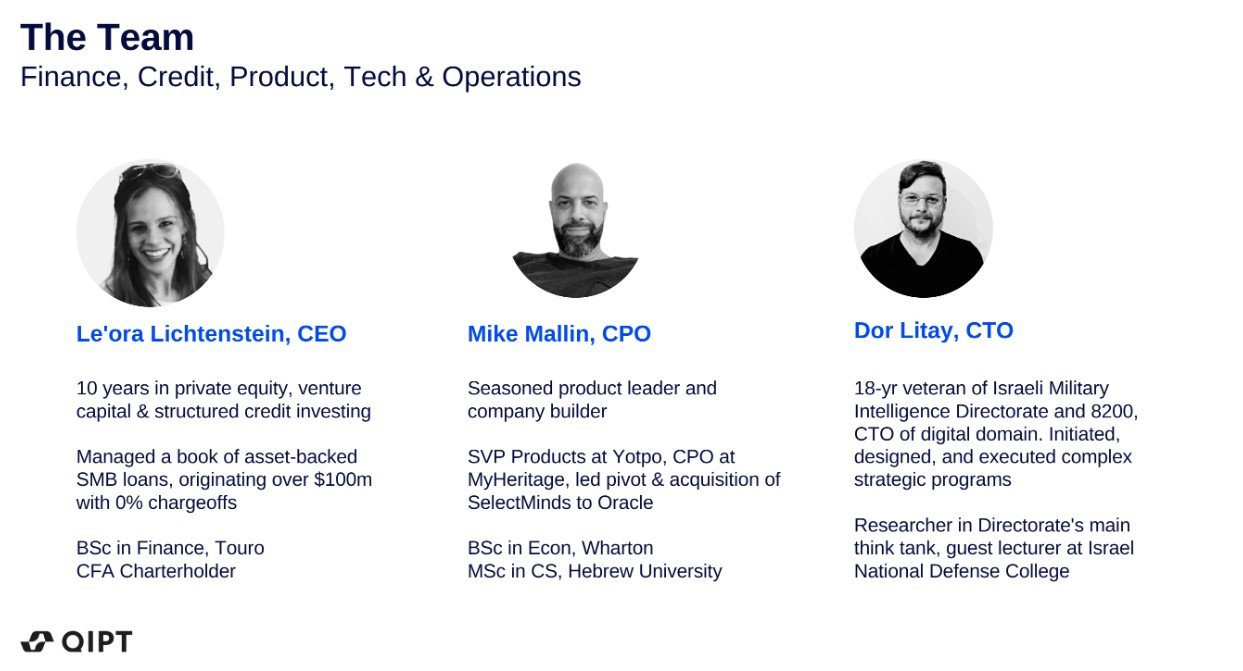
Qipt’s founding team is unique in that they come with domain expertise in equipment finance, in addition to extensive relevant experience leading product and technology teams. Worth noting, two of three co-founders, the CEO and CPO, are American born but have lived in Israel for the bulk of their professional careers, while the CTO is a native Israeli and held numerous intelligence-centric positions in Israel’s defense apparatus. In addition, Joule Partner Brian Rosenzweig had a pre-existing and long-term relationship with CPO Mike Mallin, which is both the source of this opportunity and a factor that played into our team’s investment decision.
JOULE VALUE-ADD
1. While Qipt had done extensive research on this market prior to undertaking a capital raise, they still wanted exposure to more American merchants and lenders that could not only provide additional market intel, but could also become a potential design partner or customer. As part of our due diligence, we facilitated numerous high-value conversations in the United States:
- Managing Director of Equipment Finance @ Valley National Bank (NASDAQ: VLY)
- Chief Financial Officer and Director of Retail Finance @ Alta Equipment (NYSE: ALTA)
- Vice President of Capital & Emerging Markets @ Doosan Bobcat Financial Services
- Former Chief Information Officer @ Emerson Electric (NYSE: EMR)
2. Provided guidance on round structuring, sizing and pricing to ensure they would not onboard unnecessary valuation risk going into a more volatile market than they expected at the outset of their raise. This guidance was ultimately adopted by the Qipt team and incorporated into the terms of the deal.