
Investment - June 2023
The Joule General Partners are pleased to announce the execution of Limited Partnership IV’s 12th investment in an Israeli founded emerging technology company. Below you will find information about the business and corresponding investment. We welcome your questions and feedback.
DEAL SUMMARY
Company Name / Pynt
Website / www.Pynt.io
Offices / Tel Aviv, Israel
Sectors / Cyber Security, DevOps
Founders / 3
Year Founded / 2022
Number of Board Positions Held by Joule / One
Total Joule LP IV Investment / $2,000,000
Total Size of Round / $4,000,000 (Seed)
Notable Co-Investors / Dallas Venture Capital, Honeystone Ventures, and Strategic Angel Investors
LP IV Ownership / 15.4%
TECHNOLOGY DESCRIPTION
APIs or Application Programming Interfaces are the software intermediaries or gateways that allow two applications to communicate with one another. With the rapid evolution of tech, the explosive growth of mobile and web applications, and the accelerated digital transformation amongst enterprises, APIs have become mission critical to modern day business. Without fast, reliable, accurate, and secure APIs, businesses are unable to effectively communicate with and service their customers. In fact, according to Akamai, 83% of all Internet traffic currently comes from some form of API. To continue putting things into perspective, large banks with millions of customers handle tens of millions of API calls daily. For this reason, enterprises are directing considerable developer resources at API production and maintenance. According to Slashdata, 90% of software developers are using APIs in some capacity and spend roughly 30% of their time coding APIs - the second most time-consuming task for developers.
One of the biggest challenges with APIs is ensuring their security and integrity. Because of how much data is flowing through these APIs from a variety of sources, hackers have found them to be an appetizing entry point into an enterprise network where they can wreak havoc in terms of exfiltrating valuable data, stealing Personally Identifiable Information (PII), or holding ransom or extorting companies for sums of money. In 2022 alone, U.S. companies lost up to $23 billion just from API data breaches. However, securing APIs is difficult as there continues to be the internal struggle between developer velocity and security best practices. Compromising results in either slowed software production or costly breaches, both of which have significant impact on shareholder value. To date, most API Security products in the market are targeting post-API production ‘Threat Detection’, which are often hard to use, require experienced security personnel (already in short supply), and can impact business continuity if not implemented correctly.
Tel Aviv-based Pynt’s view is that API Security should be ‘baked’ into the API development process so that when those APIs are pushed into production they already have their vulnerabilities or weak spots identified and fixed. This ‘Shift Left’ security strategy also eliminates the aforementioned compromises by allowing API developers to accelerate production while giving security teams the management and oversight they require. To do this, Pynt is building the market’s first fully automated API Security Testing platform, which fits seamlessly into existing developer workflows to test the integrity of each API, which today 93% of developers do, but manually. Pynt’s ‘secret sauce’ is the developer-friendly ‘autopilot’ that acts like a hacker with human logic - generating attacks on APIs in development and eliminating the vulnerabilities before they are exposed.
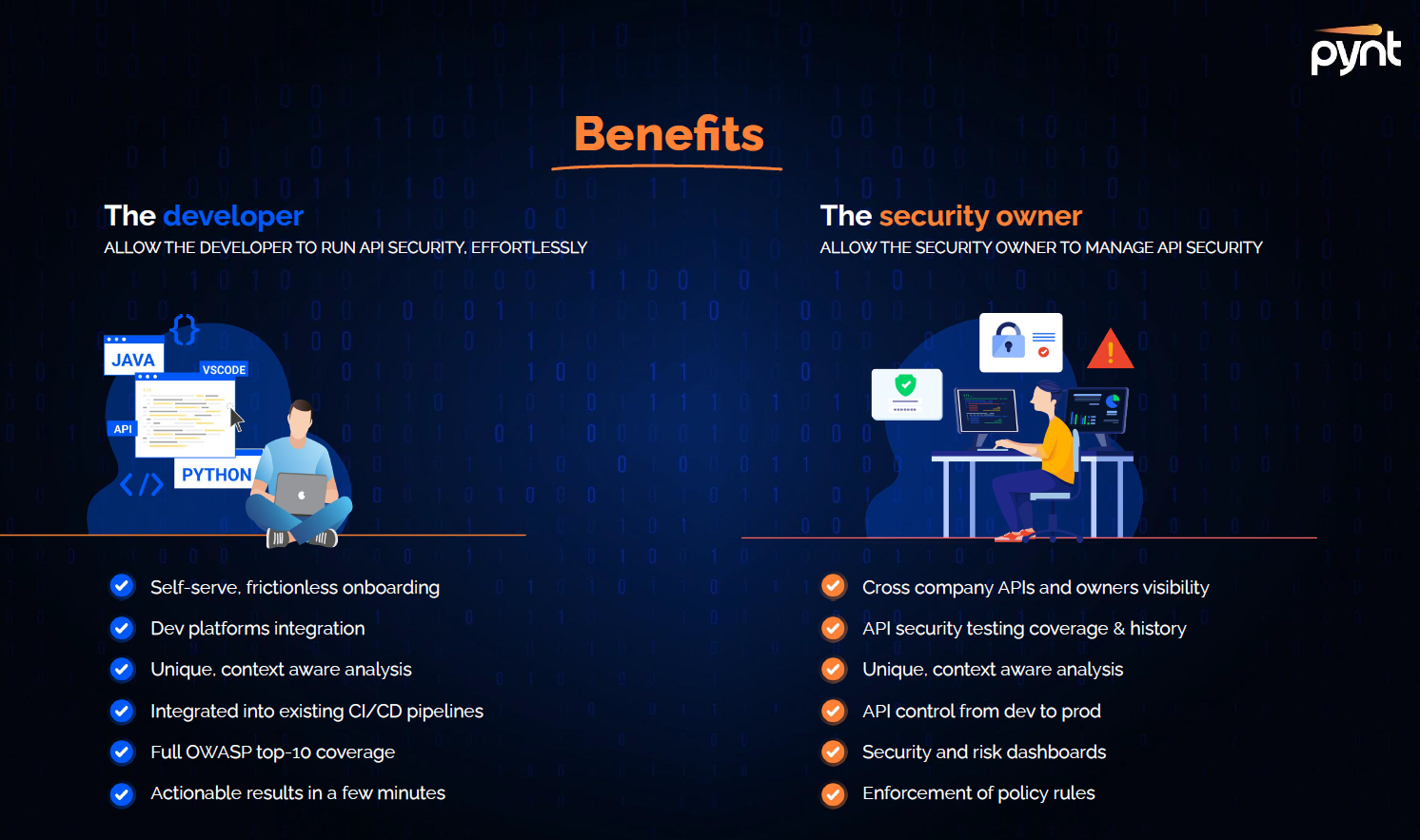
While API Security Testing is the initial focus, Pynt believes that their approach and technology can also have a major impact on the broader Software Testing industry, which by 2030 is expected to be a $70 billion market. Applying Pynt’s automation and ‘test on the go’ approach, developer teams can deploy software as a whole much faster and with significantly lower costs.
MARKET ADOPTION
Pynt has a far more mature product in market than we typically find with a seed stage company. Today Pynt has 2,000 developers across 400+ organizations in more than 70 countries using their platform. To achieve this, Pynt has quickly integrated with most of the big players in the API market such as Postman and RapidAPI, while also heavily marketing themselves in online developer communities, which has attracted users from some of the largest brands in the world:
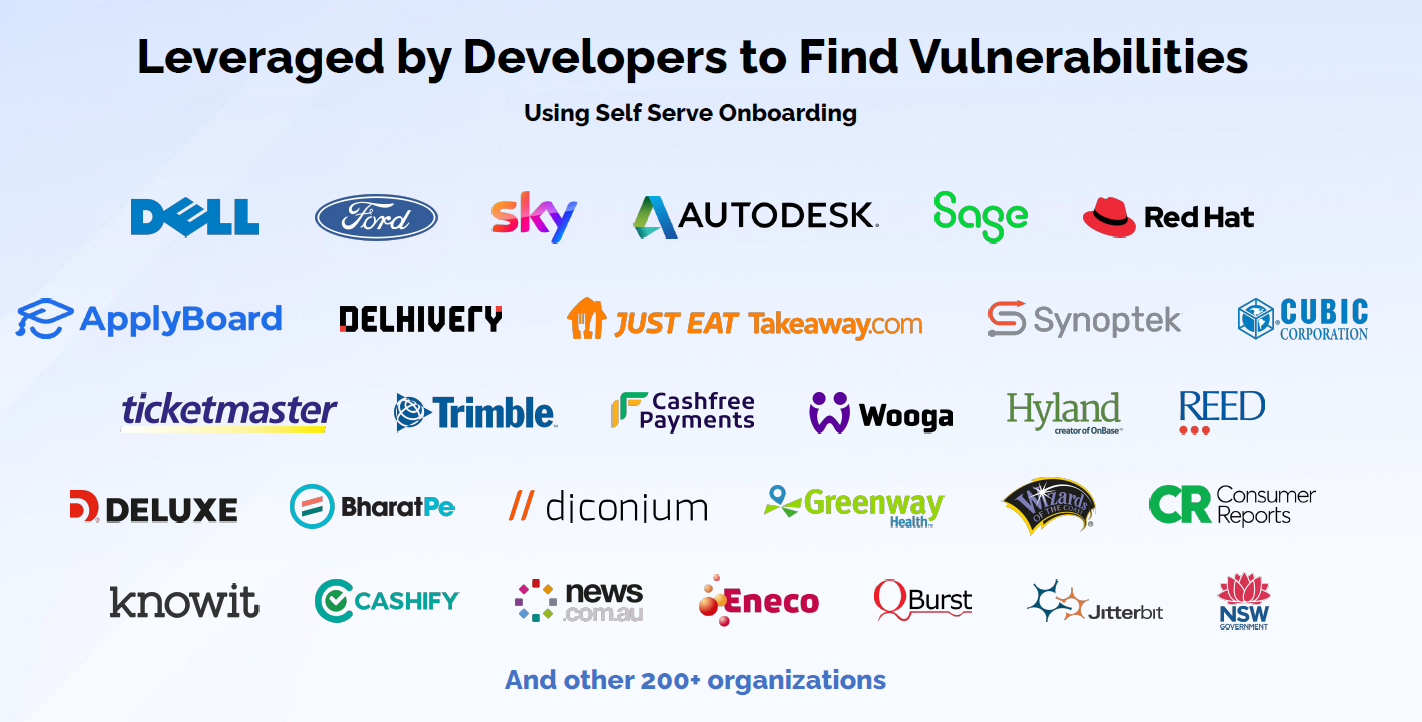
In terms of their traction to date, what makes Pynt even more interesting is that the bulk of their users are inbound and signed up to use their product via a self-serve motion. This kind of momentum is incredibly rare for a year-old company. However, Pynt doesn’t just want to rely on a bottoms-up (Product-Led Growth) strategy and is working on building out their top-down sales function starting with a number of API-first enterprise design partners.
EXECUTIVE TEAM
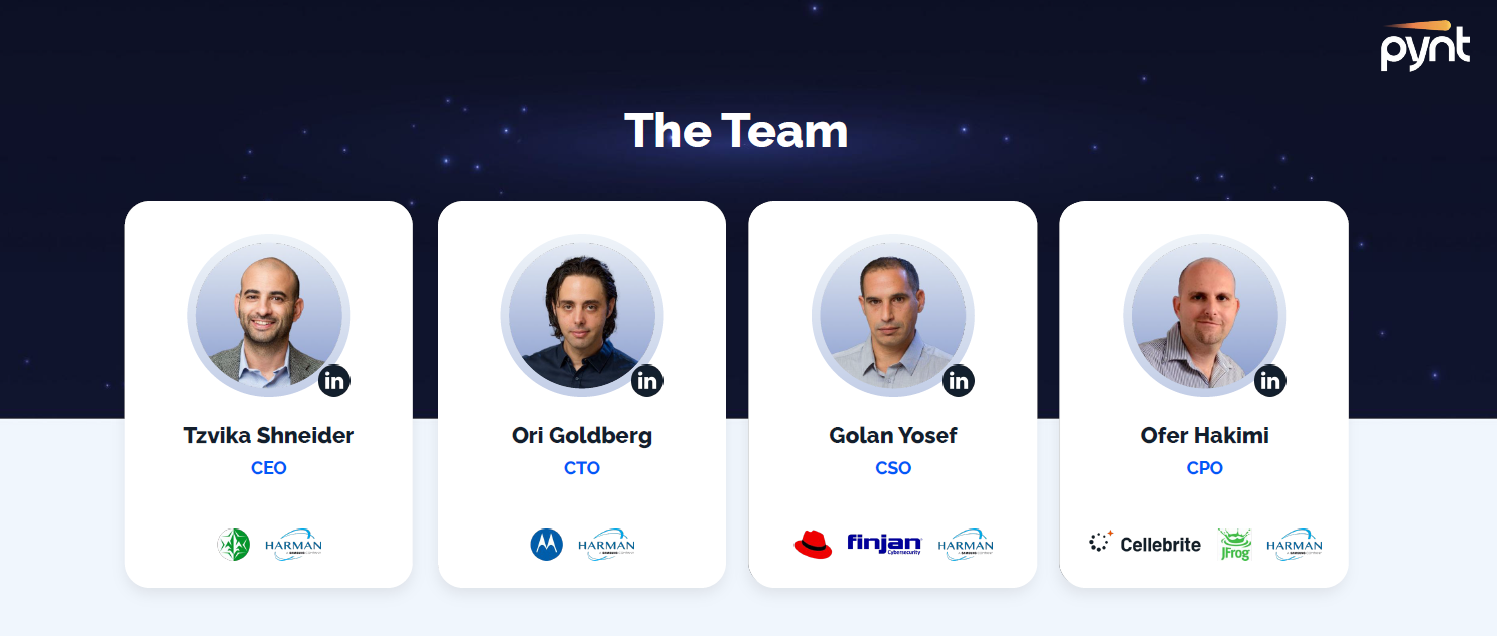
Pynt’s executive team are serial cyber entrepreneurs who were responsible for building the market’s first automotive application security solution for developers, which back in 2016 was acquired by Harman, the automotive subsidiary of Samsung. What makes this team even more unique, and lethal from an operational perspective, is that they joined forces again to tackle a major problem in the security space. More often than not when a group of talented cyber technologists start and sell their business, the founders go their separate ways with their new ventures. In this case, the dynamics and trust between the co-founders was the impetus for them embarking on their second security venture together. We’ve been very impressed with the focus, execution, and vision of this team and have a high degree of confidence in their ability to carve out meaningful market share in the API Security market.
JOULE VALUE-ADD
1. Pynt’s pre-seed round a year earlier was executed at fairly aggressive terms, which would create unnecessary dilution for the founding team that could add risk to their retention down the road. In response, Joule conducted an extensive pre-round effort to ensure that the terms of Pynt’s aforementioned pre-seed round were retroactively adjusted to shield them from this extraneous dilution, while at the same time keeping Pynt’s cap table investment grade for future capital raises. This effort, perhaps just as important as preserving a healthy cap table, was a significant investment in building long-term loyalty amongst the company’s founders.
2. Joule was responsible for syndicating the remainder of the round to the two other venture fund participants — Dallas Venture Capital and SF-based Honeystone Ventures. This allowed for Pynt to dramatically cut down on the time required to raise the remainder of the round, thus allowing the founders to return their focus to building the business and capitalizing on their inbound momentum.